BMI Calculator
Calculate your BMI (Body Mass Index) with interactive gauge visualization, health category assessment, BMI Prime, healthy weight range, and step-by-step calculation breakdown.
Your ad blocker is preventing us from showing ads
MiniWebtool is free because of ads. If this tool helped you, please support us by going Premium (ad‑free + faster tools), or allowlist MiniWebtool.com and reload.
- Allow ads for MiniWebtool.com, then reload
- Or upgrade to Premium (ad‑free)
About BMI Calculator
Welcome to the BMI Calculator, a comprehensive tool for calculating your Body Mass Index with interactive visualization, detailed health insights, and step-by-step calculation breakdown. This calculator is designed for adults aged 20 years and older and provides personalized health assessments based on your BMI category.
What is Body Mass Index (BMI)?
Body Mass Index (BMI) is a numerical value calculated from your weight and height that serves as a screening tool to categorize weight status. While BMI does not directly measure body fat percentage, it provides a useful estimate to determine whether a person has a healthy body weight relative to their height.
BMI is widely used by healthcare professionals, researchers, and public health organizations worldwide as an initial screening tool for weight-related health risks. However, it should be considered alongside other health indicators and is not a diagnostic tool on its own.
BMI Formula
BMI can be calculated using either imperial or metric units:
BMI Categories
The World Health Organization (WHO) defines the following BMI categories for adults:
| Category | BMI Range | Health Risk |
|---|---|---|
| Underweight | Below 18.5 | Increased risk of nutritional deficiencies |
| Normal Weight | 18.5 - 24.9 | Lowest health risk |
| Overweight | 25.0 - 29.9 | Increased risk of health problems |
| Obese | 30.0 and above | High risk of weight-related conditions |
Understanding BMI Prime
BMI Prime is the ratio of your actual BMI to the upper limit of normal BMI (25). It provides an easy way to understand how your weight compares to the healthy threshold:
- BMI Prime < 0.74: Underweight
- BMI Prime 0.74 - 1.00: Normal weight
- BMI Prime 1.00 - 1.20: Overweight
- BMI Prime > 1.20: Obese
Limitations of BMI
While BMI is a useful screening tool, it has several important limitations:
- Does not distinguish muscle from fat: Athletes and muscular individuals may have high BMI without excess body fat
- Does not account for fat distribution: Belly fat (visceral fat) is more dangerous than fat in other areas, but BMI cannot detect this
- Age considerations: May underestimate body fat in older adults who have lost muscle mass
- Ethnic variations: Health risks may occur at different BMI levels for different ethnic groups
- Not suitable for: Pregnant women, children, or highly muscular athletes
Health Risks Associated with BMI Categories
Underweight (BMI < 18.5)
- Nutritional deficiencies
- Weakened immune system
- Osteoporosis risk
- Fertility issues
- Anemia
Overweight and Obesity (BMI ≥ 25)
- Type 2 diabetes
- Cardiovascular disease
- High blood pressure
- Certain cancers
- Sleep apnea
- Joint problems
How to Use This Calculator
- Select your measurement system: Choose Imperial (feet/inches/pounds) or Metric (centimeters/kilograms)
- Enter your height: For imperial, select feet and inches. For metric, enter centimeters
- Enter your weight: In pounds for imperial or kilograms for metric
- Click Calculate: View your BMI, category, BMI Prime, healthy weight range, and personalized insights
Frequently Asked Questions
What is BMI and how is it calculated?
Body Mass Index (BMI) is a numerical value calculated from your weight and height. For imperial units: BMI = (weight in pounds × 703) ÷ (height in inches)². For metric units: BMI = weight in kg ÷ (height in meters)². BMI is used as a screening tool to categorize weight status.
What is a healthy BMI range?
A healthy BMI for adults aged 20 and older is considered to be between 18.5 and 24.9. This range is associated with the lowest health risks. However, BMI should be considered alongside other factors.
What is BMI Prime?
BMI Prime is the ratio of your actual BMI to 25 (the upper limit of normal weight). A value of 1.0 means you're at the threshold between normal and overweight. Values below 1.0 indicate healthy weight.
Is BMI accurate for athletes?
BMI may overestimate body fat in athletes and muscular individuals because it cannot distinguish between muscle and fat mass. Athletes should use additional measures like body fat percentage.
Can children use this calculator?
This calculator is designed for adults 20 years and older. For children and teens (ages 2-19), BMI is interpreted using age and sex-specific percentiles, which require different calculators.
How often should I check my BMI?
Checking your BMI monthly or quarterly can help track weight management progress. However, focus on overall health indicators rather than BMI alone.
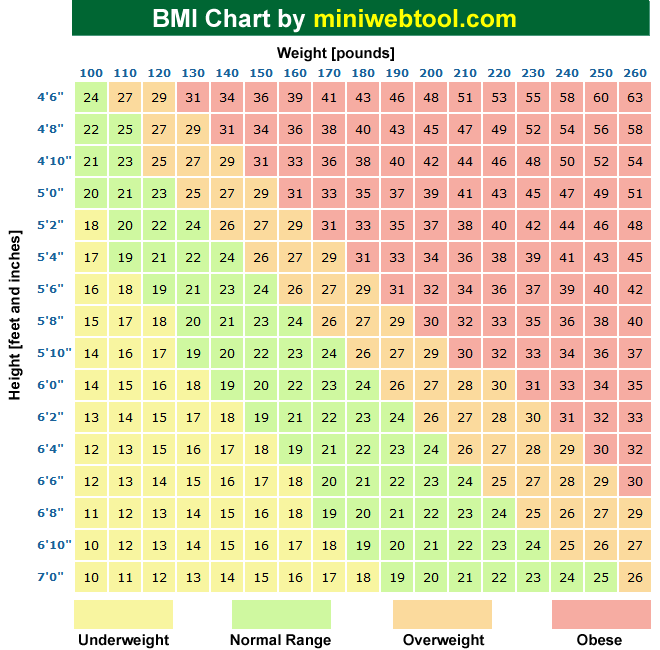
Standard BMI Chart
You can also use the following standard BMI Chart to determine your BMI visually based on your height and weight.
Reference this content, page, or tool as:
"BMI Calculator" at https://MiniWebtool.com// from MiniWebtool, https://MiniWebtool.com/
by miniwebtool team. Updated: Jan 29, 2026